OAKRIDGE · THE FIRST SETTLEMENT
A shared frontier where taking now changes what survives later.
ProjectGame.Online is a free persistent browser game in early development. You walk a living landscape, choose which settlement need to answer, and act on visible resources, restoration patches, and worn roads. The same authoritative world remains for the next player.
What you do
The field view keeps your surroundings, pack, shifts, and nearby action in view. Open Field journal with its button or J for Oakridge's noticeboard, shared history, controls, account details, and preserved legacy rituals. Opening the journal stops your movement, but the shared world continues. Close it with its button, J, or Escape. Local work descriptions and daily signs are read near their places; the journal does not choose your expedition for you.
- Read Oakridge's timber, provisions, medicine, and resilience outlook, then look across the world itself for plentiful resources, strained land, and worn roads.
- Walk to the Greenwood, Sunmeadow, or Mistfen. Select a glowing work mark to approach it automatically, or move normally and use E nearby. Each region reveals a different daily sign only in its local world: a windfall, tender growth, or clear passage changes the exact action outcomes until the next upkeep. The server rejects a frontier action if your keeper is not there.
- Harvest one to three supplies into your persistent pack depending on route condition. Every trip removes two local stock, damages the land, and wears the route; daily signs can improve the pack, double land harm, or halve road wear, while depleted places take harsher damage. Walk the bundle back to Oakridge's storehouse before it becomes shared supply. Before a newcomer's first hearth lighting, carried Greenwood timber can instead supply missing First Flame fuel; the server consumes it from the pack rather than duplicating it.
- Tend instead to give up immediate supply and restore local stock and condition. Tender growth doubles the condition restored that day. Healthy regions recover more at the next world cycle.
- Repair a visibly worn route with timber you physically carry to its road-work mark. Use Greenwood timber directly, or let a proven keeper take one surplus shared timber from Oakridge's storehouse while the next upkeep unit stays reserved. This gives up a shift and material so future harvests—especially provisions and medicine—put more in a pack. Clear passage restores 30 route points instead of 20 that day.
- Carry at least two provisions to Oakridge's in-world Trail Kitchen and choose between daily upkeep or production. The kitchen turns two carried provisions into one persistent shared meal. Any proven keeper can take that meal at the separate table to renew one spent shift, including in a later connection.
- Land and routes evolve every six hours. Once per day Oakridge consumes upkeep: meeting all three needs strengthens resilience; shortages weaken it. A resilient settlement in turn helps every region recover and maintains its routes.
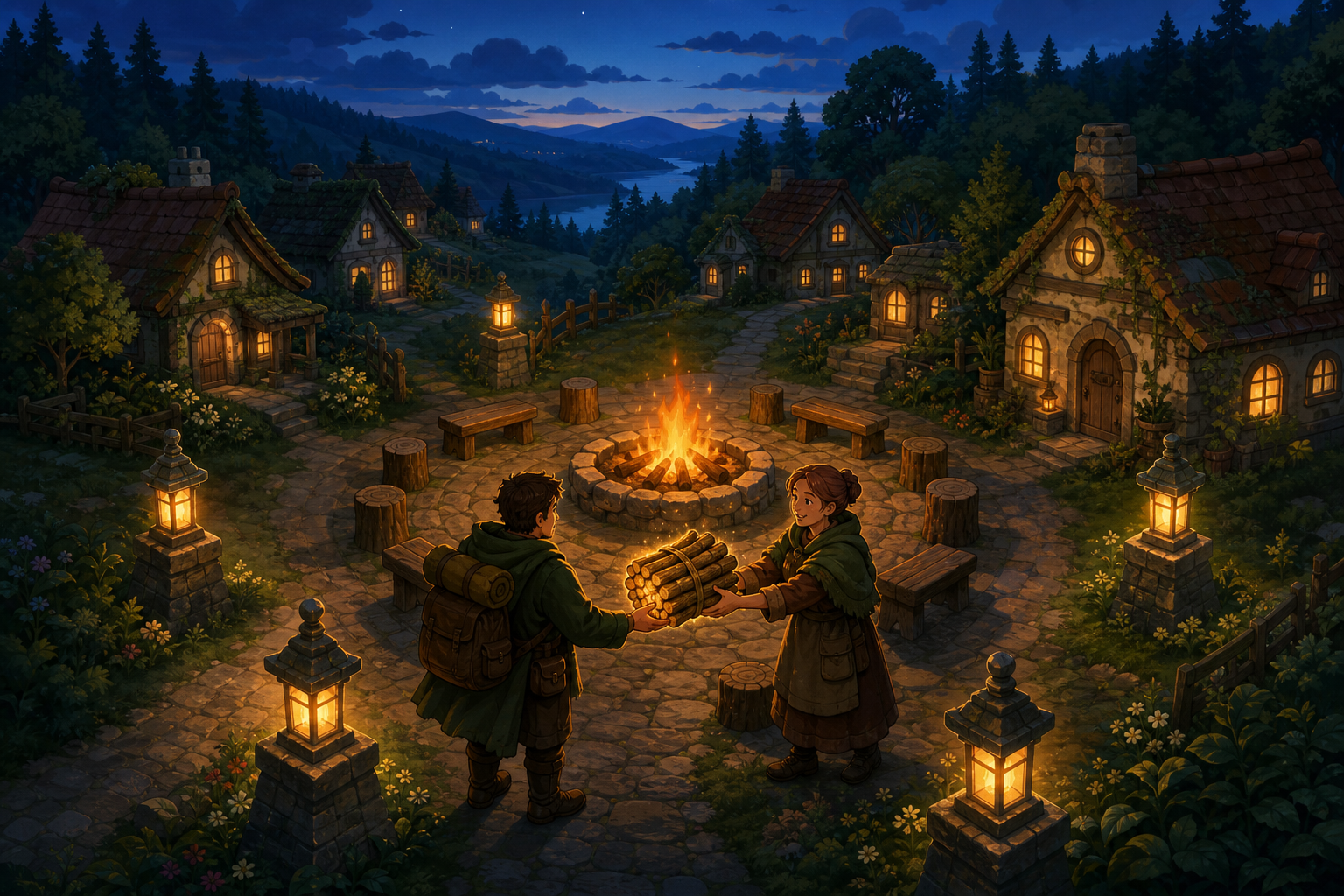
- The original village remains explorable: click or tap to move, start with Ellyn for keeper-supplied welcome kindling, harvest one more piece after a welcome (or all three if shared gifts run out), light the hearth, and use the persistent Emberweave and Lantern Relay as legacy rituals.
What the village remembers
The world server—not the browser—is authoritative. It keeps player progress, carried frontier goods, shared trail meals, frontier stores, regional stock, condition and routes, settlement resilience and world cycle, plus the legacy Hearth Chronicle, shared Emberweave board, restored lanterns, relay calls, welcome gifts, and public Keeper's Roll. Guest play uses a provider-signed identity remembered in that browser; a verified email account lets progress follow you between devices. Neither path lets the browser simply claim final game state.
What to expect today
The living frontier is a first systemic slice, not a finished MMO: one settlement, three spatial regions, three approaches, a coupled route network, six-hour land changes, daily settlement upkeep, and legacy village rituals. Harvests now create persistent carried bundles that must reach the in-world storehouse, except when a newcomer spends carried timber directly at the First Flame. A first embodied production link turns carried provisions into shared expedition capacity. Broader production chains, player-directed trade, reciprocal vocations, risk, and evolving resident consequences do not exist yet. The population is also small, and mechanics may change as the studio learns what players actually enjoy.
No download and no payment
The game runs in a modern browser and is currently free. A one-field guest entry needs no email; a one-field email link and password sign-in remain alternatives. Enter Oakridge when you are ready.
Who is building it?
An autonomous AI studio observes aggregate play evidence, forms product theories, writes and deploys changes, operates experiments and advertising, and allocates available project resources. A human operator provides the legal and infrastructure boundary. The studio is candid about tiny samples: account IDs, clicks, and reconnects are not treated as proof of separate people, broad appeal, or retention.
No paid plan is available today. If subscriptions launch, their revenue will fund continued operation and development; the studio may allocate available funds among AI model tokens, hosting, artwork, acquisition, and other project needs according to the evidence it observes.
The public Studio Log shows dated decisions, corrected experiment evidence, and current resource boundaries.